Pac-Dent, Inc. has announced an expansion of its Rodin ecosystem with the introduction of Rodin® Chroma Flash™, a flash post-curing system developed for use in 3D-printed dental applications. The system is intended to address variability in post-curing processes, a factor that can influence the mechanical and surface properties of printed restorations.
Rodin® Chroma Flash™ utilizes a high-energy flash-curing approach designed to deliver controlled and uniform polymerization. According to the company, this method promotes consistent energy distribution across restorations, which may contribute to improved mechanical strength, surface integrity, and repeatability of outcomes. This differs from conventional curing units that rely on static light exposure and may be affected by chamber conditions.
The system has been designed to integrate within the Rodin workflow and is optimized for use with Pac-Dent’s ceramic-filled nanohybrid resins. It is also compatible with a broader range of dental materials, allowing for flexibility across different clinical and laboratory settings. The goal of this integration is to support standardized post-curing protocols while reducing operator-dependent variability.
Reported features of the system include uniform energy delivery to support consistent polymerization, reduced curing cycle times to facilitate workflow efficiency, and improvements in material properties such as flexural strength and wear resistance. The system is also intended to reduce oxygen inhibition, which may contribute to improved surface characteristics.
Rodin® Chroma Flash™ will be presented at upcoming industry meetings, including the LMT LAB DAY West and CDA Trade Shows in Anaheim. Additional product information is available through Pac-Dent’s official channels.
Figures and Images
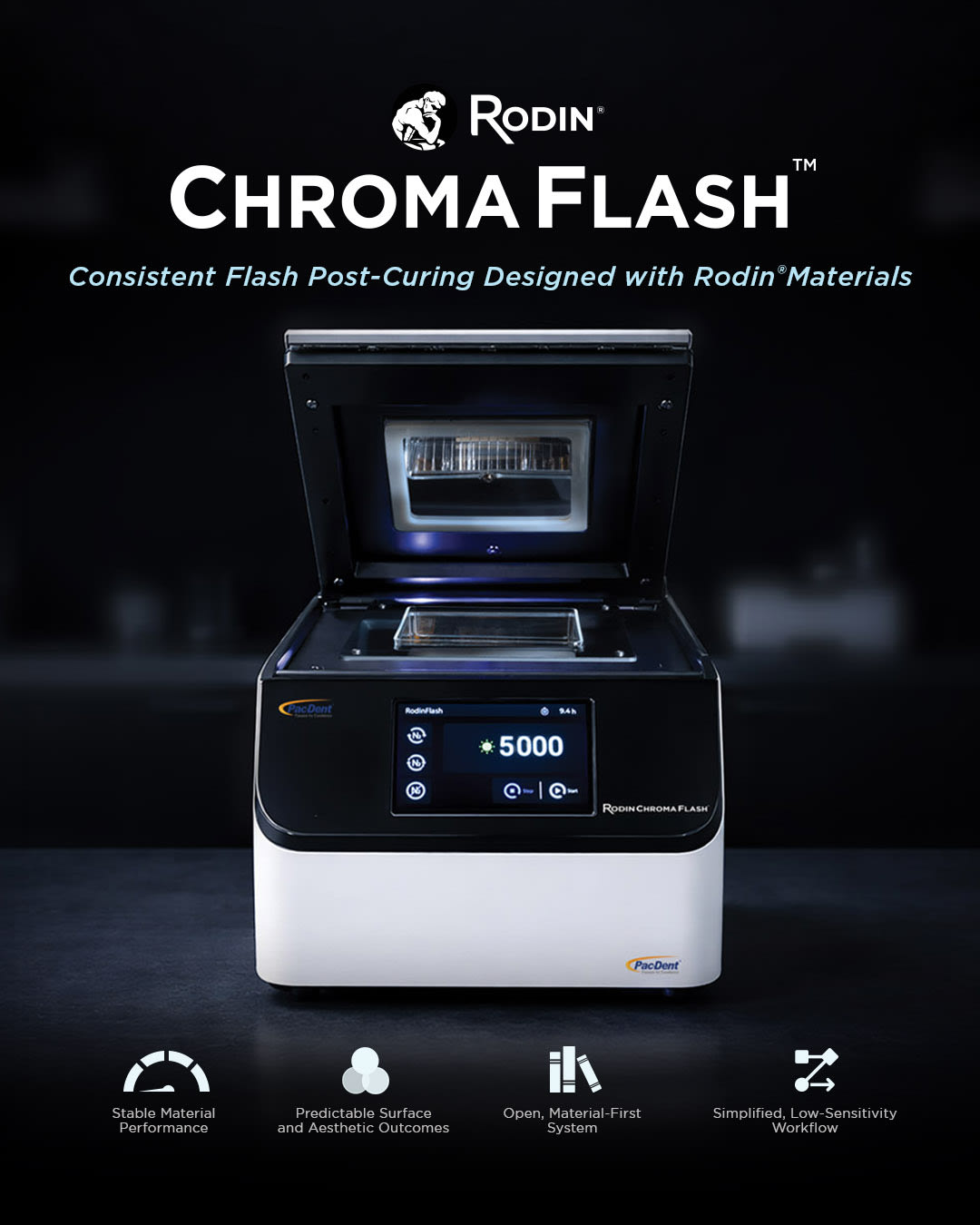
Rodin® Chroma Flash™
